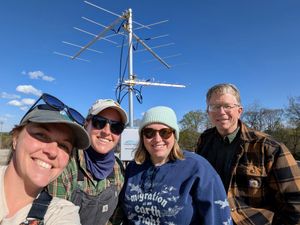
Led by Joe Poston, professor of biology at Catawba College, Nicole M. Baran, professor of biology at Davidson College, and Jeff Thomas, professor of biology at Queens University, the project expands the reach of Motus, an international research network that uses radio telemetry to track the movement of birds, bats, and insects.
The three institutions recently installed four 10-foot towers as part of the effort. While the Motus network includes more than 2,400 towers globally, coverage in the Charlotte region has remained limited, with the new stations expanding monitoring capacity across the Piedmont. Three towers were installed on college-owned lands with the fourth on private property in the Uwharrie Mountains. They join a station installed at UNC Charlotte in Fall 2025.
“The Piedmont is a crucial link in many birds’ migratory patterns, but we could not track them as they passed overhead,” said Jeff Thomas, biology professor at Queens University. “By expanding the Motus network, we can quantify the birds that come through the area.”
How it Works
The system relies on tiny radio transmitter “backpacks” placed on animals by researchers. Because each tag is unique, the towers can recognize individual animals as they fly overhead.
- Real-Time Results: The stations were installed over the winter and are already registering travelers.
- High-Speed Migration: On May 5, a tagged male thrush passed Catawba College at 9 p.m. Just seven hours later, it pinged a tower near Philadelphia—a 400-mile journey completed at over 60 miles per hour.
- Long-Distance Insights: Data revealed the same bird was tagged last summer in Massachusetts and had recently returned from wintering in Central America.
Community Science
The project was supported by a five-figure grant from the North Carolina Biotechnology Center, which funded the stations and provided tagging supplies. Tagging is expected to begin this fall, with Catawba College environment and sustainability faculty Bahy Abdelmesih and Andrew Jacobson also assisting with the effort.
Cape Fear Bird Observatory consulted on the installation of all four stations, providing technical expertise and creating a hands-on learning opportunity for students who assisted with the installation process.
“This project has been a fantastic opportunity to cooperate with scientists at Davidson and Queens,” said Poston. “And it has given our students a chance to participate in cutting-edge conservation biology. I am pleased with our progress and am eager to tag some migratory birds to see where they go!”
Anyone can follow tagged birds in real-time by visiting motus.org.
“The thing that's cool about Motus is that the data is publicly available,” said Davidson College biology professor Nicole M. Baran. “This invites everyone—students, citizens, researchers—to learn about the populations of birds with whom we share the world.”
Photo: Left to right: Marae West, Evan Buckland (both of Cape Fear Bird Observatory), Nicole Baran (Davidson College), Joe Poston (Catawba College). Photo at Davidson College.
