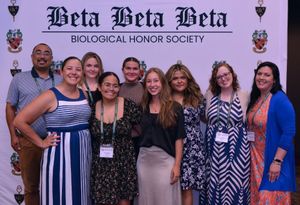
Six students and four faculty members from Catawba’s biology program attended the convention May 27-30 at Florida State University in Tallahassee, Florida. Held every two years, the national gathering brings together undergraduate students and their faculty research mentors to present original research, exchange ideas, and connect with scientists from across the country.
Catawba seniors Alex Baquie, Samantha Giraldo, Jacy Noble, McKenzie Peurifoy, Luke Roberts, and Hailee Smith presented original research at the convention. Faculty research advisers attending were Dr. Jay Bolin, Dr. Carmony Hartwig, Dr. Amanda Rushing, and Dr. Erin Witalison.
Catawba’s Tau Eta chapter of Beta Beta Beta, commonly known as TriBeta, received third place for the Lloyd M. Bertholf Award for Outstanding Chapter of the Year for 2024-25. The chapter is co-advised by Witalison and Rushing. Hartwig currently serves as president of the national Beta Beta Beta Biological Honor Society.
Catawba students also earned two national honors in the John C. Johnson Award for Excellence in Poster Presentations:
- First place: Luke Roberts, Examining the Diversity and Protective Functions of the Salamander Microbiota, advised by Rushing.
- Third place: Jacy Noble, Biochemical Analysis of the Microbiome and Proteome of Dog Saliva, advised by Witalison.
For Roberts, the convention provided an opportunity to share work that grew from a year of research at Catawba.
“Being able to share my research at the TriBeta National Convention was an important moment for me,” said Roberts, a recent biology grad. “My work was the culmination of a year-long passion project that allowed me to study native salamander conservation and ways they might benefit human health. Going to the convention allowed me to reconnect with my fellow Catawba alumni, my Catawba Biology professors, and meet many other talented student and professional researchers.”
Recent biochemistry graduate Alex Baquie said independent research gave her an opportunity to put his classroom and laboratory experience to work in new ways.
“My time working on an independent research project at Catawba has been so fulfilling in expanding my knowledge outside of the classroom and in practically applying skills I have learned in the lab,” said Baquie. “Being able to present this research alongside so many other young scientists at the TriBeta National Convention was an exciting experience that allowed me to meet others in my field and to receive important feedback from other researchers.”
Independent research is an important part of the science experience at Catawba. Students have opportunities to pursue projects across disciplines including molecular biology, genomics, microbiology, ecology, and botany. Beginning as early as their junior year, students can develop individualized research questions and carry projects from initial investigation through analysis and presentation with close faculty mentorship.
"Through undergraduate research, students have the opportunity to move beyond the classroom and engage directly in the process of discovery,” said Rushing from Catawba’s Biology department. “Through close mentorship, students gain hands-on experience and develop problem-solving skills while building the confidence to tackle complex questions. These highly personalized research experiences not only prepare students for graduate study and professional careers but also foster the curiosity and creativity that are at the heart of a transformative education."
The national recognition reflects the opportunities Catawba students have to develop as scientists through meaningful research, close faculty collaboration, and experiences that prepare them to take their work beyond campus.
