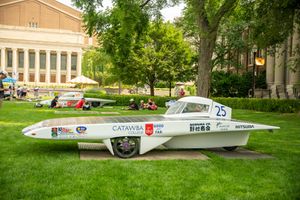
Catawba College arrived in Minnesota this summer ready to race a solar-powered car. By the time the team reached Amarillo, Texas, nearly two weeks later, its students had accomplished something bigger.
Catawba College’s solar racing team was presented with the Dr. James Hill Sportsmanship Award at the conclusion of the 2026 American Solar Challenge, recognizing the team’s willingness to step in when competitors needed help. The honor capped an extraordinary first major competition for a young team representing one of only three non-engineering schools among 39 colleges and universities participating this year.
From the forests of Minnesota to Route 66 and the plains of West Texas, the experience became a demonstration of what happens when technical learning, perseverance, generosity, and teamwork meet the open road.
“This team showed exactly what we hope students will discover at Catawba: that success is not defined only by where you finish, but by how you respond to challenges and how you use what you have to help others move forward,” said Dr. Lee Ball, Vice President of Sustainability at Catawba College. “Our students earned the respect of an international community of solar racers, and they built a foundation that will carry this program far into the future.”
A Challenge Before the Starting Line
The journey began at Brainerd International Raceway in Minnesota with the Formula Sun Grand Prix, where teams must first pass an intensive series of technical and safety inspections known as scrutineering.
For five days, Catawba students worked through nearly every stage of the demanding process. Despite their limited racing experience, the team advanced farther through inspections than several universities with established engineering programs.
Then came a setback no amount of preparation could overcome.
A defective battery module prevented Catawba’s car from completing the final requirement needed to take the track. The issue came after countless hours of preparation, including an overnight work session as students made final adjustments to the car.
Instead of ending their experience, the setback changed its direction.
The students stayed engaged, learned from veteran teams, studied race operations, and continued building the knowledge needed for Catawba’s next competition.
“The character of this team became clear in that moment,” Ball said. “They had every reason to be disappointed, but they did not disengage. They kept learning, kept working, and looked for ways to contribute. What followed became an experience none of us could have planned.”
The competition itself became an immersive classroom. Students worked alongside teams from institutions around the world and interacted with recruiters and industry professionals representing organizations including Blue Origin, SpaceX, Siemens, Tesla, General Matter, and Wattch.
Several Catawba students said the intensity of their week at the track accelerated their learning in ways traditional coursework alone could not.
For Ball, who has spent his career in higher education, the experience offered a compelling example of hands-on learning.
“The combination of innovation, experiential learning, self-discovery, teamwork, and leadership development was remarkable,” he said. “Students were solving real problems, under real pressure, alongside people who are among the best in the world at what they do.”
From Competitors to Teammates
Following the Formula Sun Grand Prix, the team traveled to Minneapolis for the American Solar Challenge, beginning with Display Day on July 24 at the University of Minnesota.
The road race began the following day, taking competitors south along portions of the Great River Road and historic Route 66 toward Amarillo.
Catawba initially planned to follow its partners from Appalachian State University and provide assistance as needed. The College’s relationship with App State has been instrumental in the development of Catawba’s solar racing program, giving students opportunities to learn from one of the nation’s most accomplished teams.
But Catawba’s role soon expanded.
At the race’s first official stage stop at Southern Illinois University Edwardsville on July 27, École de technologie supérieure of Montreal, known as ETS, encountered serious problems with the truck used to haul its trailer.
Catawba had the equipment to help.
After consulting as a team, Catawba offered its truck and trailer and became embedded with ETS for the remainder of the competition.
The arrangement gave Catawba students an unexpected opportunity to experience the inner workings of an internationally accomplished solar racing program. ETS placed ninth in the previous World Solar Challenge, and Catawba students joined the team for race operations, meals, camping, and the day-to-day rhythm of competition.
The partnership also strengthened an existing connection between the two programs. Catawba had already made plans to purchase ETS’ previous-generation solar vehicle, Eclipse 11, which will help advance the College’s racing program as students prepare for future competitions.
Then another call for help came.
On July 31 in Elk City, Oklahoma, the University of Waterloo contacted Catawba after its lead vehicle broke down before the final stage to Amarillo. Without a replacement, Waterloo’s ability to complete the race was in jeopardy.
Catawba again stepped forward.
For the final leg, a Catawba vehicle became Waterloo’s lead car, traveling directly in front of its solar vehicle and helping guide the team safely toward the finish.
By then, Catawba students had already learned how a lead vehicle operated through their time embedded with ETS. What began as an opportunity to observe another team became knowledge they could immediately put into practice for someone else.
“Our two goals for this experience were to make one lap on the track and learn as much as possible from other teams,” said Mark Ivaniv, Catawba’s Solar Racing Team Lead. “Every time we had an issue with the car we refused to give up, and the only thing that prevented us from reaching one goal was out of our control, an old faulty battery module. Then we had the opportunity to embed with professional teams that have been doing it for years and learn as much as we possibly could about their team structure, logistics, and strategy. I’m proud of every single team member for what we overcame and I appreciate their willingness to help other teams in need.”
Good Goes Far
When the American Solar Challenge concluded, the teams Catawba had supported had plenty to celebrate.
Waterloo completed the race with a team composed entirely of first-year students. ETS finished third in the Single Occupancy Vehicle class and won the fourth stage of the competition. Appalachian State won the Multi-Occupant Vehicle class, becoming the only school to win the category twice in American Solar Challenge history, following its previous victory in 2021.
Catawba had played a role in helping all three move forward.
Then, at the closing awards ceremony, it was Catawba’s turn to be recognized.
The team received the Dr. James Hill Sportsmanship Award for its support of fellow competitors throughout the American Solar Challenge.
For a program still establishing itself in collegiate solar racing, the award represented something more meaningful than a finish position.
“Our students went into this competition hoping to prove that they belonged,” Ball said. “They came home knowing they do. They showed technical ability, resilience, leadership, generosity, and a willingness to put the success of the larger community alongside their own. Good truly went far on this journey.”
The experience also gave Catawba students a clearer picture of what comes next.
With knowledge gained from teams across North America, an expanding partnership with Appalachian State, a strengthened relationship with ETS, and Eclipse 11 joining the program, Catawba Solar Racing is already looking toward its next starting line.
This time, the team will arrive with something it did not have before: experience earned mile by mile, problem by problem, and relationship by relationship.
And an entire solar racing community that now knows the name Catawba.
