While “viral” environmental fads can be more attention-grabbing and easier to commit to, Catawba College chose a more enduring path: investing deeply and consistently in both environmental education and sustainability as a shared responsibility for everyone who learns, works, and engages on campus. From the beginning, Catawba has viewed the environment as one of its greatest teaching tools. Today, the campus is a Living Learning Laboratory that continues to evolve, deepening student learning and equipping students to apply knowledge, values, and daily practices in their own communities.
"As an educator, I practice and encourage my students to model deliberate action within their communities and to share knowledge with peers, colleagues, and others around them," says Dr. John Wear, Associate Professor of Biology and Director Emeritus, Center for the Environment.
This commitment to sustained engagement has positioned Catawba as a nationally recognized leader in sustainability and developed a distinctive culture on campus where sustainability guides administrative action, shapes student learning experiences, and enriches the atmosphere of the campus community and beyond. Each day, that influence shows up in the conversations and daily choices of the campus community, built steadily over time rather than overnight.
Planting the Seeds
Catawba’s commitment took root in the early ‘90s with the faculty’s growing interest in developing an environmental program. Dr. Wear joined the College, ruminating on the latest findings from the United Nations Conference on Environment and Development (UNCED), also known as the 'Earth Summit', held in Rio de Janeiro, Brazil. One of the key messages from the conference was that top-down policies alone won’t drive the change needed; we must pair them with action through communities, local governments, and grassroots activity.
“I was interested in how, as a small college, we could develop something where we really focused on making and helping facilitate and educate the region and tie that directly in with the work we do to educate students,” said Dr. Wear.
Wear set to work with a small group of faculty, partnering with different organizations and engaging with other local entities to foster change in and around the college. The faculty envisioned an environmental program that would prepare students to solve emerging environmental challenges while strengthening the College's connection to the region. At a time when sustainability was only beginning to emerge as an academic field, Catawba focused on environmental stewardship, systems thinking, and community-based learning.
Its work in the early 90s set the tone and literally the landscape for the College. In 1996, the Center for the Environment was founded with a mission to involve the College and its students in programs and activities that foster environmental stewardship, not only on campus but in the region, the state, and beyond. In addition to hosting conferences and other outreach initiatives, the Center played an instrumental role in partnering with the City of Salisbury to plan a greenway that now encircles the campus. By 1997, the Center began efforts to place land adjacent to the College under a permanent conservation easement, one of the very first colleges in the nation to do so. Today, the Fred Stanback Jr. Ecological Preserve has grown to 189 acres of protected land.
Pivotal Points of Progress
As the Center’s work expanded, essentially operating as a nonprofit, with its reach both inward toward the College and outward toward the region, the College began making significant decisions around infrastructure and approach to building.
In late ‘90s Catawba started to shift from coal-fired steam heating to natural gas and geothermal heating and cooling systems on campus and began work on a building for the Center to operate out of.
“One thing that has been an issue, I think in the past, in terms of Green Building, is building decision-making has traditionally been top down, in our case, it was bottom up,” said Wear. “We got a lot of people engaged in how we approached the building, which was unique at the time, but set the example moving forward.”
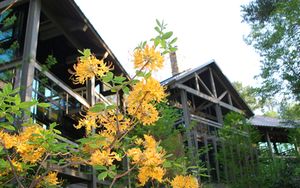
In 2001, the Center for the Environment Building was completed and became one of the first green academic buildings in the southeastern US. The passive-solar–designed building incorporated numerous forward-thinking features, including a geoexchange system that remains in operation today. In the 2000s, Catawba’s Center began to truly cement the college publicly as a leader in sustainability. It launched its award-winning Clean Air Initiative, which leveraged a multi-faceted approach through farmland preservation, sustainable development, energy conservation, talks led by subject matter experts, and more. It was featured on PBS networking both in 2000 and then again in 2005, for the College’s perspective on sustainability and unique physical setting.
Looking inward, the Center developed an advisory board of college trustees, community leaders, and environmental and sustainability changemakers, which marked a pivotal step in creating continuity in sustainability efforts. With trustees serving alongside other members, the Advisory Board established a direct link to college leadership, ensuring sustained administrative support for the Center's work. This continuity in support elevated sustainability from being seen as a complementary value to being a guiding influence in decision-making. From there, the college cultivated a sustainability influence that touched infrastructure, policies, academics, and the daily experience of every campus community member.
“I think we've had a strong continuity in administrations that have seen the value in our work,” said Wear. “The inclusion of trustees on the advisory board has helped strengthen the Center and educate the trustees, who are ultimately making those kinds of decisions, like hiring a president. I've seen programs that I thought were really successful go by the wayside with a simple change in administration.”
The 2010s saw that influence grow through partnerships and collaborations with award-winning scholars, entrepreneurs, and thought leaders who introduced the campus community to a diverse range of perspectives and contributed to meeting Catawba’s sustainability goals. . In 2014 the college installed solar on buildings throughout the campus. which at the time produced more solar electricity on campus than any of the other colleges and universities in the state – if you combined them all. In 2023 the College announced it had successfully achieved full carbon neutrality seven years ahead of its 2030 climate commitment, the 13th college nationwide to do so and first institute of higher learning in the Southeast to meet Second Nature's high standards for determining carbon neutrality.
Catawba Today
Through 2023 and 2024, Catawba secured funding through private alumni donations to launch a series of major capital projects that will set a new standard for green building, environmental education, and regenerative design in the region. The College's philanthropic partners, who believe that investing in environmental education and infrastructure creates lasting benefits for both students and the surrounding community. These projects represent the largest collective investment in campus infrastructure in the college’s history. The sustainability aspect of these projects is led by Catawba’s current Center for the Environment Executive Director and Vice President of Sustainability, Lee Ball.
"Our ‘Campus as Forest’ vision sees the college as a living, interconnected system where every decision nurtures the health of our collective ecosystem,” said Ball. “The current capital projects are the largest in our history, and they will not only redefine sustainability on our campus but set a new benchmark for the entire region. This is about designing a future where people, place, and planet thrive together.”
These sustainability projects weave innovation, history, community engagement, and environmental stewardship into the fabric of campus life. Similar to past projects where Catawba exceeded the sustainability standards of its time, Catawba is pursuing aggressive certification standards today. The College is moving beyond systems thinking to an ecosystems thinking approach, which include regenerative and Passive House design. These projects form a living model of sustainable infrastructure and an ambitious blueprint for how a campus can function as a thriving, interconnected ecosystem.
The historic Smokestack, once a coal-burning power plant, will be reimagined as an energy positive and net-zero student hub with sustainable and carbon neutral elements down to the fabric choices to the food options. The Smokestack project will pursue Living Building Challenge certification, which, if awarded, would make it the first higher education building in the state to achieve this distinction. The project will also pursue LEED Platinum certification, potentially becoming the second higher education project in the state to receive this designation. A new residence hall built to Passive House standards is on track to become North Carolina’s first Passive House (Phius)-certified residence hall, designed to achieve a 40 percent energy cost savings and an energy use intensity nearly half that of comparable facilities. It will drastically cut energy use while creating comfortable, efficient living spaces. Meanwhile, Stanback Residence Hall's partial renovation and partial rebuild is pursuing WELL Certification to enhance occupant well-being and energy performance. All three projects will integrate solar energy, be heated and cooled through a new closed-loop geothermal system that will connect 90 percent of the campus infrastructure and bring Catawba closer to realizing its zero-carbon goals.
The projects all began with the same bottom-up approach used in the early 2000s. Catawba leveraged its Student Government Association to recruit student representation and engaged the campus community early in the design and planning of these buildings. Project teams asked questions, led activities and consolidated the feedback to have projects not only meet the sustainability goals but be reflective of its student body.
A Better Future
More than three decades after faculty first envisioned an environmental program, Catawba continues to educate students through a combination of programming, its campus environment and a vast network of partnerships. They built a campus culture that reflects its values and ideals that students and staff internalize. The College has gotten creative and persuasive in managing the conversations and the business case to take ideas off the page into a reality.
“Despite having the resources to fund these projects, it didn’t mean that it was easy,” said Ball. “We had to methodically build a value proposition that minimized risk while supporting recruitment and retention at the same time. It requires an appetite for a certain amount of risk and a willingness to be innovative. It’s how we've been able to tackle decarbonization and deferred maintenance simultaneously in a systematic, integrated approach.”
Catawba College is leaving a lasting legacy that goes far beyond the bricks and mortar of its campus. Students, past and present, experience a campus that balances energy efficiency with human well-being and environmental responsibility. A mindset rooted in history committed to pushing the boundaries of what a college campus can achieve. Catawba is shaping generations of students by teaching integrated problem solving and collaborative team building and leadership, ensuring that the college’s impact extends well beyond its grounds.
You can learn more about Sustainability at Catawba College on our website: https://www.catawba.edu/sustainability/
