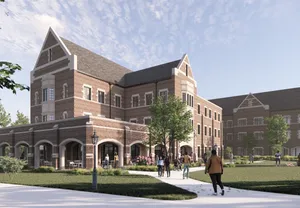
The scaffolding is coming down. Brick wraps the exterior. Limestone is set around windows and entrances. From the east side of campus, the tower rises above the trees and is settling into the skyline as though it has always been there.
Catawba College has named its newest student residence Centennial Hall, marking 100 years since the College moved from Newton to Salisbury in 1925.
The name recalls one beginning and looks toward another.
When Catawba relocated to Salisbury a century ago, the College came to a community willing to invest in its future. The campus grew one building at a time, each adding to the life students would come to know here. Centennial Hall now enters that line of buildings, shaped by memory and built for the years ahead.
It draws from the architecture that has long defined Catawba’s campus. Brick, limestone, and steep rooflines give the building a familiar presence. The College seal sits above the east entrance, reminding us of Catawba’s historic Ideal: Scholarship with Character and Culture for Service. Inside, its systems, materials, and infrastructure reflect a different kind of long-term thinking.
For Bill Graham ’83, those ideas were never separate.
Bill and Shari Graham met at Catawba as students, graduated together in 1983, and have remained among the College’s most generous supporters. Years after graduation, Bill reflected on driving through campus and looking toward the Duplex, now Ruth Richards House, where he lived as a student.
“I still have an emotional attachment to the place and a lot of good memories,” he said in 2000.
As plans for Centennial Hall took shape, Graham followed the project closely and returned often to the same conviction: a new residence hall should feel as though it belongs to Catawba while preparing the College for its future.
“Centennial Hall is the perfect marriage of Collegiate Gothic architecture and sustainable design and technology,” Graham said.
That marriage extends beyond what can be seen from the outside.
Centennial Hall is designed to pursue Passive House certification, making it the first residence hall in North Carolina built to that standard. Its high-performance building envelope is expected to reduce heating and cooling demands. The hall will also connect to Catawba’s district geoexchange energy system, reducing dependence on fossil fuels while serving the campus for decades to come.
It will house 130 students in 112 rooms. At least three layers of sound insulation separate the rooms, and each includes a dedicated wireless access point. Shared spaces include outdoor patios, lobby, kitchen, and Great Room, with study areas and bathrooms located at the end of each hall.
Around the building, native plantings, rain gardens, gathering spaces, and pedestrian connections continue the College’s Campus as Forest vision, where the landscape itself becomes part of the educational experience.
For rising senior Amal Ahmed, the building has become part of campus even before students have moved inside.
“As I’ve gotten closer to graduation, I’ve found myself appreciating campus in a different way,” she said. “You begin to notice the places that become part of your daily life. Centennial Hall will be one of those places for a new generation of students.”
Ahmed has watched the residence hall take shape throughout the past year. What stands out to her is not simply that it is new, but that it already feels like it belongs.
“It’s new from the inside—but from the outside, it blends well,” she said. “It keeps what I like about the campus.”
For now, Centennial Hall still belongs to the people finishing it. Hard hats rest on window ledges. Drywall dust settles overnight. The sounds inside are the sounds of construction.
Soon, that will change.
Students will carry boxes through the front doors. They will learn which chair in the Great Room is always taken, which window catches the late afternoon light, and which hallway is quiet before an early exam. They will make the building part of their own routines without giving it much thought.
Years from now, many of them will return to campus and find themselves looking toward Centennial Hall the way Bill Graham once looked toward Ruth Richards House.
By then, the building will have done what the best college buildings do.
It will have become part of someone’s life.
Learn more about the Centennial Hall project on our Capital Projects page.
