Alumni Story
David Messick ’84
David Messick ’84
More Than Just Good Theatre
Hometown: Hampton, VA
You don’t leave Catawba without an impressive skill set.”
David hadn’t planned to attend Catawba College. “I got a dance scholarship to another school. My dad and I drove to visit that school. It must have been a holiday; the parking lots were empty. It was a maze of buildings and no one we spoke with seemed to know where anything was. The dance instructor, one of the great Russian ballet instructors and the reason I was going there to study, tells me, ‘By the way, I’m retiring.’ Then, I met with the theatre department head who said, ‘If you’re lucky, you’ll get to direct a show in your senior year.” David and his dad went back to their car; the only car in the lot, parked where they thought they were supposed to park. And they’d been given a ticket. That was all they needed to know.
A handwritten note from Dr. Hoyt McCachren, then head of Catawba’s theatre department, drew David to Catawba. Visiting campus, David saw a lot of theatre students onstage, building sets and he loved it. Theatre was his first love. For him, dance was about income. “I choreographed shows because I could make money. While at Catawba, I would fly home on weekends to choreograph shows for dinner theatres,” he explains. “I always knew, from the first time I saw a live touring theatre company out of New York, that I was going to produce children’s theatre.”
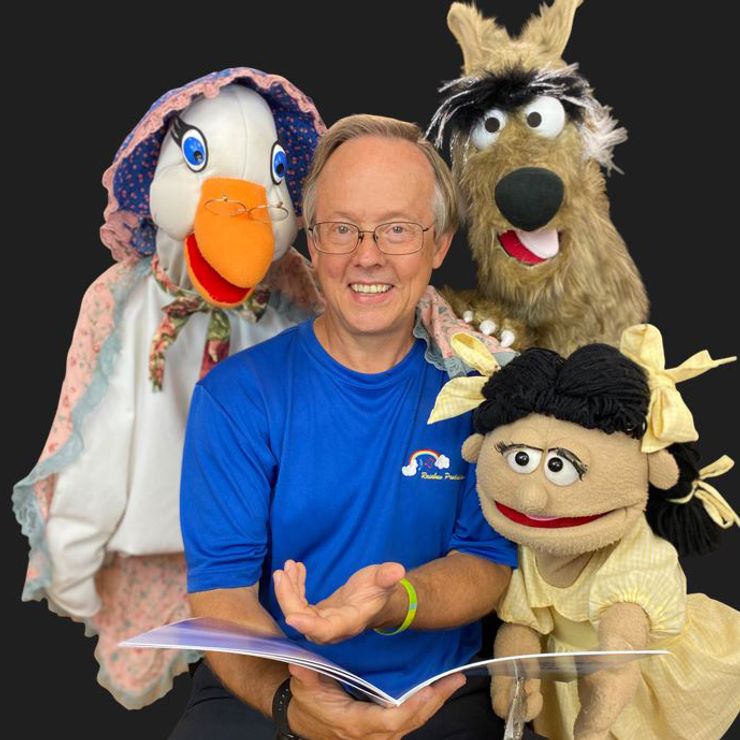
Rainbow Productions, David’s company, came about while he was working at a library as a teen. “The library director said she wasn’t able to find a puppet company to do a show. I told her, ‘You just found one.’ David made the heads for marionette puppets, his mother made costumes for them, and friends painted. Rainbow Productions has been performing from 1977 through present day; 2027 will be its fiftieth year.
Pivotal in bringing David to Catawba, Dr. McCachren also played a role in David’s career. The final semester of David’s senior year, restaurant chain Chuck E. Cheese held auditions for someone to work puppets and do voices for their new characters. David got the job, which started before graduation. In an era before online classes, he called Dr. McCachren, whose theatre history class he needed to graduate. David says, “I told him, ‘You know me, I’m going to do all the work.’ Dr. McCachren said yes. I was able to take the job and started producing commercials and doing character voices for Chuck E. Cheese during their first heyday.”
Then the restaurant recession hit. David found a new job with Audience Studies, Inc., in California. “They had a place called the Preview House on Sunset Boulevard. That’s where every TV show of the 1960s had been tested. You didn’t get to be on TV unless you showed the pilot episode there. People would say, ‘I like that, I don’t like this,’ and make decisions on whether that show was going to be produced or not. Shows like “The Monkees” and “I Dream of Jeannie” were tested there first.”
David managed their market research for all the TV pilots. “I worked on the “Oprah Winfrey Show.” I worked also worked on the “Star Trek” series, which was huge because at that time there had never been a syndicated show that cost over a million dollars an episode. We did the test pilot for it and people loved it.” David adds, “We were the people who started Fox Entertainment as the fourth network. We tested all their original pilots.”
The internet began to change that business, and David moved on to marketing for the “Chicago Tribune” whose papers included the “Daily Press” in his hometown. He created commercials and marketing campaigns used in major newspapers nationwide.
David still values what he learned at Catawba. Theatre arts professor, James Parker, taught costuming. “Parkie was tough. But everybody learned how to thread a sewing machine,” David says. “In scene shop, you learned to drive a nail. You don’t leave Catawba without an impressive skill set.”
Dr. McCachren’s theater history class continues to shape his approach to shows. “You had to do so much reading about so many styles of theatre,” David says. “Playwright Bertol Brecht insisted the purpose of theatre was to teach. I thought that was the biggest line of hooey I had heard. I came from the Mickey Rooney/Judy Garland school of theatre, which was to put on a show and have fun. Then you get to be 30 or 40 years old, and I’m in front of 200-300 children a day doing theatre. You realize, you can perform a show, but what are we teaching? What are they learning? Why is this story important?”
“Playwrights tell you that you don’t want to interpret a show at the end, you let people find what they need. But with kindergarteners, first and second graders, we ask, ‘What did you think of this story?’ An example is the story of the three pigs. I’ll say, ‘Those first two pigs built out of straw and twigs and did it quickly. Was that a good plan?’ The kids yell no! ‘The third pig built out of bricks. Was his plan good?’ They yell yes!” David adds, “The lesson is, ‘Before I take action, stop and think.”
The children are also given books; over a quarter million to date. “We’re going to tell them three or four things about the Wright Brothers, for instance, then they get a book they can read with their family to learn more.” David wrote sixteen books that are distributed.
Rainbow Productions is a calling for David. He has another, unanticipated calling. His son Luke loved soccer. Luke learned online about a group of orphan soccer players in Ghana, and began communicating with them, asking them about playing soccer. He discovered they didn’t have shoes, uniforms, or equipment. David explains, “Luke got that in his heart and got all of his soccer friends to donate shoes.”
At age 22, Luke died in a tragic car accident due to a distracted driver. David shares about grief, “As a Christian, as a parent, as a person you have a choice. Do I fall down this horrible hole, or do I find a way to make this mean something? Within a day of him passing away, we knew that we had to do something. We created a nonprofit, Luke Messick Futbol Charities. We send soccer coaches to Ghana for two weeks every year and take close to 500 pounds of soccer shoes and equipment. Every month we provide water, food and supplies to the kids. School in Ghana is free, but you have to have twenty dollars to pay for uniforms and books. In Ghana, that is a lot of money. My elevator speech is, ‘Look, for what you’re going to spend for lunch today, you can send a kid to school for a year.’ Anyone who knows me, the idea that I’m running soccer tournaments would be something they’d never expect. It’s a place where God placed me, but it’s also a place where I never expected to be.”
When in Ghana, David does theater productions in the schools. That brings his thoughts back to Catawba. “Parkie was a taskmaster. Yet everyone adored Parkie. For his class, I created a show that was to be a touring production. He wanted me to design bigger. He said, ‘David, you’ve got to stop designing shows based on whether or not they fit in a Volkswagen van.”
David did learn to scale up. Then he learned to scale down. Both times involved a whale. “We were hired to be the opening of the Virginia Festival of Puppet Ministries. We created the biggest, most impressive puppet production of “Jonah” ever. An entire theater turned into the inside of a whale. One puppet was nine feet high; the puppeteers would have to get inside to operate it. During the performance, we’re bringing up the city of Nineveh, it’s so heavy and big the stage begins to topple. An audience member came up to help hold the stage up. We got a standing ovation, but it was probably because Nineveh didn’t fall on us.” David laughs, “That show was so big that anytime we were asked to do it, I would sell them on one of our smaller shows.” Then David sensed God wanted him to take “Jonah” to Africa. For that it had to fit into a suitcase. He created a version that does. “Our very biggest show became our very smallest show. It literally is so easy to travel.”
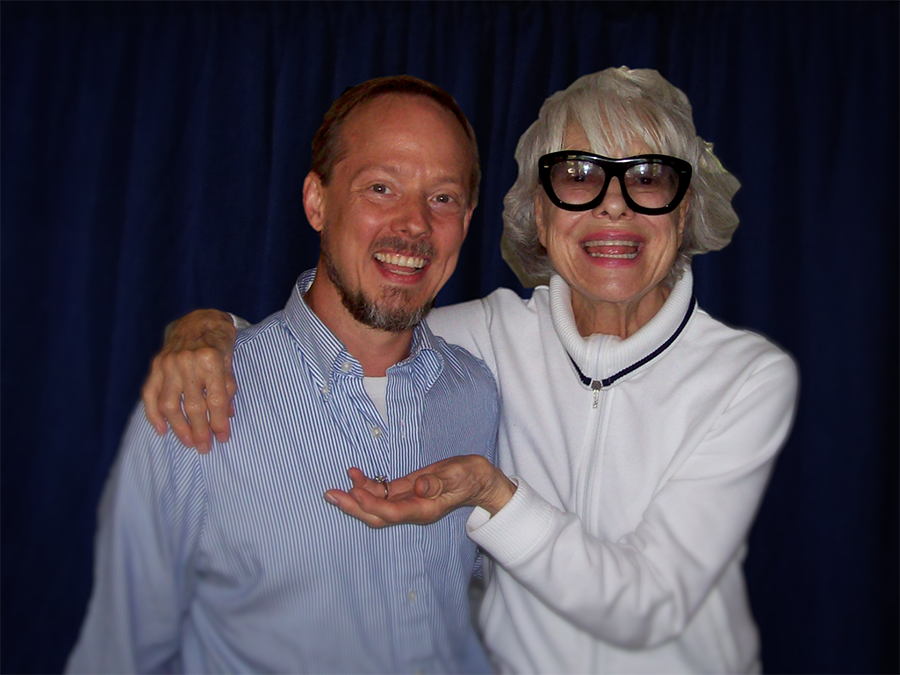
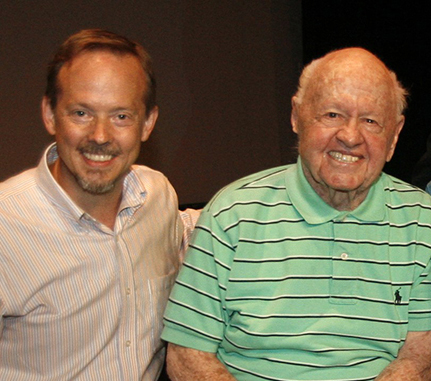
David’s calling has brought other opportunities, like working with theatre greats including Mickey Rooney, who performed seven shows with Rainbow Productions, and with Carol Channing. David shares, “After seeing an octopus-like dance move that Carol Channing did with LL Cool J on the Tony Awards, I flew to Boston where she was performing and stood by the stage door waiting for her.” He was looking for the right person to play an octopus in his upcoming production. David told her about his show and said, “You’ve got to be an octopus.” David recounts, “Carol turned to her husband and asked, ‘Do you think I should? He said, ‘I guess so.” And she did. David adds, “She was just a delight. You may think you know her voice, but trust me, her voice is an octave lower than you think.”
Catawba is pleased to note that David Messick was inducted into the Blue Masque Hall of Fame in 2025.
