The Mycelium Effect
Striving to create the conditions for regenerative outcomes in all we do is an audacious goal. It will take all of us.
Catawba is leading the way in doing what is right. We are creating and embodying the conditions that foster the critical thinking, bold innovation, and responsible leadership necessary to drive transformative change today and into the future while also restoring and regenerating ecological communities. Our participatory, multi-disciplinary, and outcomes-driven collaborations will ensure all members of our ecosystem can contribute to and benefit from the flourishing of the Catawba ecosystem.
CENTERS OF EXCELLENCE
Embodying Regenerative Education & Leadership
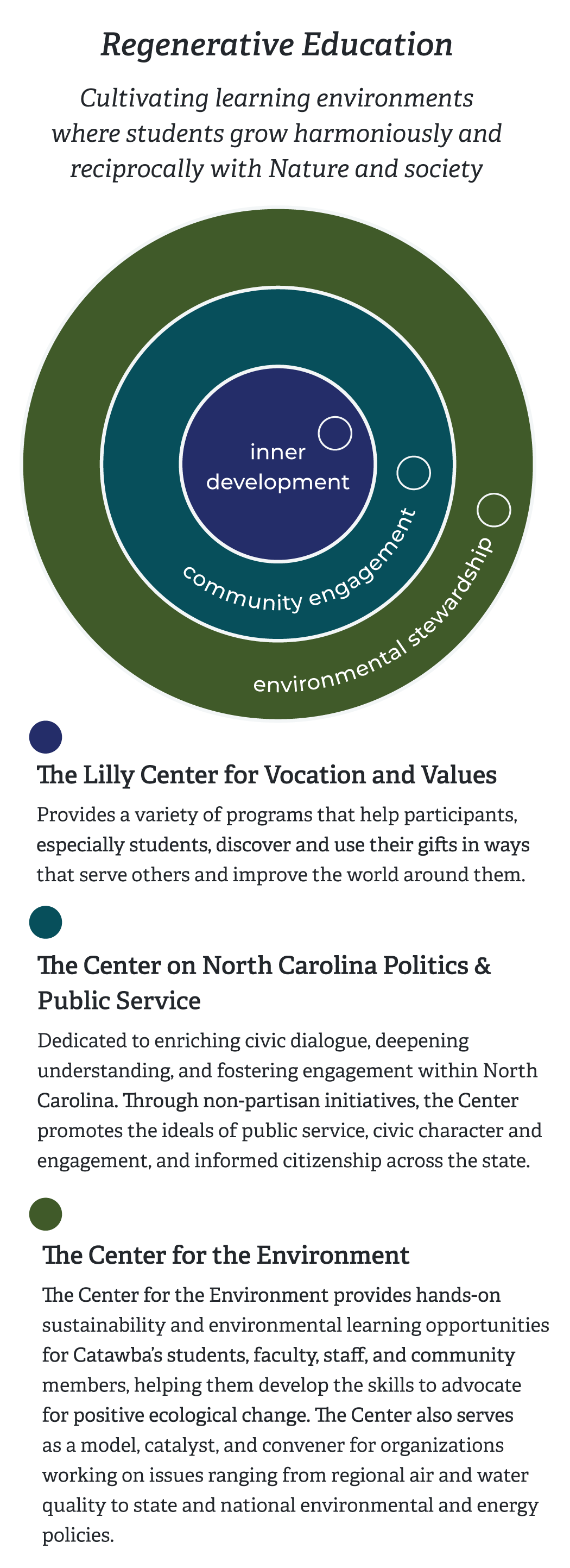
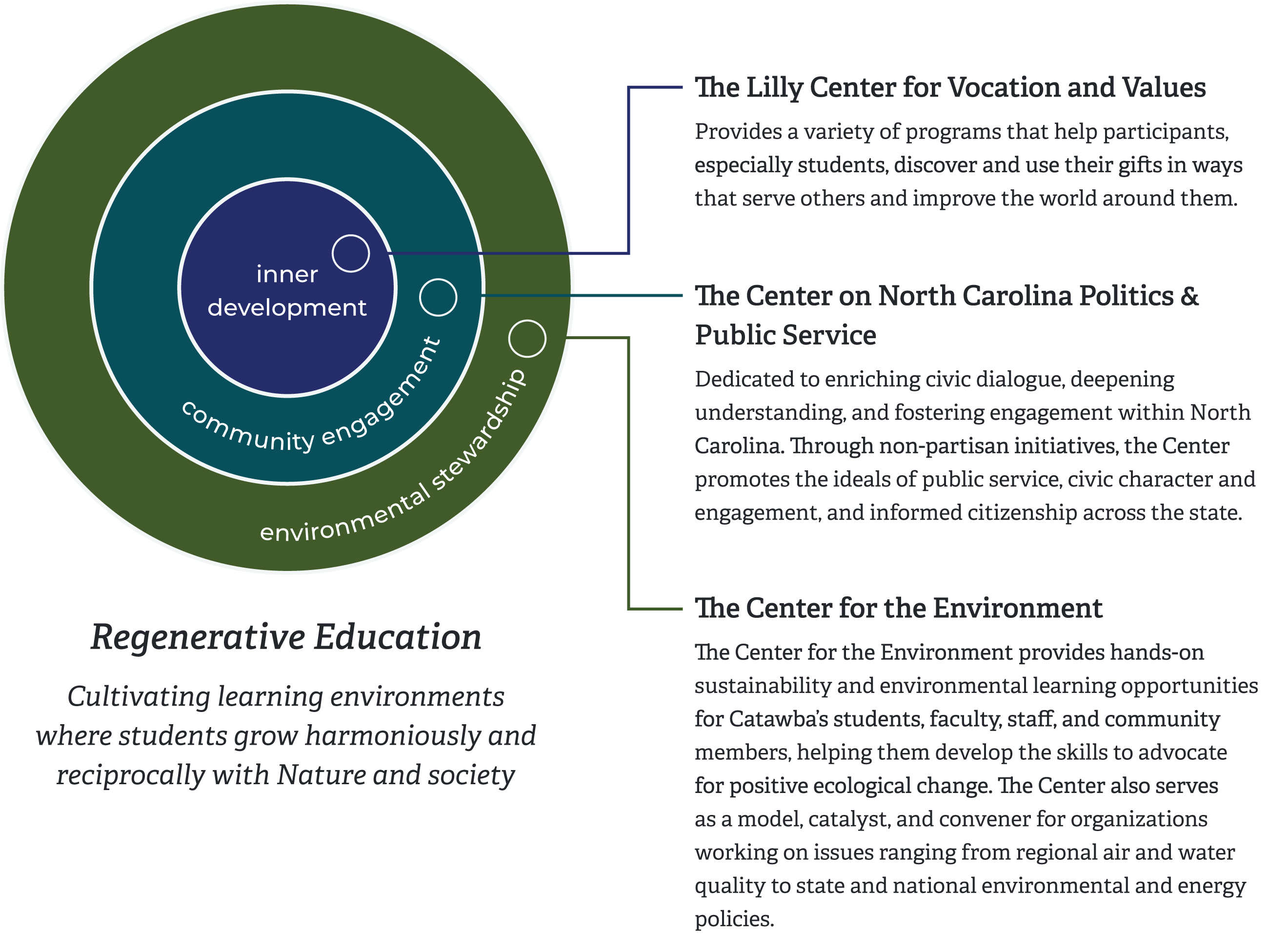
Catawba’s centers of excellence align with the core components of regenerative education – student wellbeing, community engagement, and environmental stewardship. Campus as Forest establishes a clear shared purpose for collaboration across the three centers: to create a unique system of support that enables and builds capacity for students to explore their relationship to the larger whole and discover their unique individual potential to serve as informed global citizens for their communities and the planet.

FACULTY AND STAFF
Co-creating industry thought leadership
Campus as Forest leverages the knowledge and expertise of Catawba faculty and staff to transform Catawba into an nternationally renowned living-learning laboratory.
Centered on the shared purpose of fostering positive impact in everything we do including on-the-ground positive impact for Nature, will provide the opportunity for Catawba faculty and staff collaborate to innovate, adapt, and integrate this vision into Catawba’s academic programs and Centers of Excellence, advancing and sharing knowledge within their field of study while creating a distinctly Catawba student experience grounded in the Catawba ideal.
Together, we have the opportunity to redefine STEM/STEAM education by introducing “STREAM” education with regenerative thinking at the center, sparking curiosity and creativity while fostering a deep understanding that we are embedded within, dependent upon, and stewards of Nature.
STUDENTS
Preparing for the 21st century
Our holistic Campus as Forest approach integrates student learning and engagement at every opportunity. Emphasizing critical thinking skills, systems-thinking, ethical decision-making, and the power of diverse perspectives, we are empowering our students to be compassionate future thinking global citizens that can create, adapt, and thrive in harmony with the world around them.
Students will have the opportunity to engage in a multi-faceted interdisciplinary regenerative education that combines values thinking, academic theory, and practice that supports integrated problem-solving skills to develop a foundation of environmental literacy.
Regardless of their area of study, students will have the opportunity to take tangible actions and measure impact through place-based experiential learning, connecting classroom learning to real-life contexts in their field of study.
Through these experiences, students will gain a deep intra-personal and interpersonal understanding of the pathways for fostering interconnected regenerative outcomes for the environment, human communities, and personal wellbeing.
CAMPUS + COMMUNITY
Collaboratively regenerating Nature
As an outcomes-based approach rooted in connection, diversity, and regeneration, Campus as Forest boldly invites and encourages collaborative problem-solving with partners within and beyond our campus around a shared goal of regenerative impact.
Our thoughtful integration of sustainable and regenerative design turns the Catawba campus into a destination, providing an exceptional campus experience for students, faculty, staff, and visitors alike.
Our transformative work on campus will position Catawba as a regional hub of regenerative innovation, showcasing sustainable design and landscapes as models for the regenerative built environment of the future.
Our Center for the Environment will convene regenerative thought leaders from our region and beyond to share knowledge, advance regenerative design practice, and expand our network of opportunities.
Fungi: Ecosystem Engineers
Fungi, which form vast underground networks of mycelium in soils, are vital players in nearly all terrestrial ecosystems on Earth.
As ecosystem engineers, fungi play integral roles in shaping landscapes and the planet’s nutrient, carbon, and biodiversity systems, making them crucial partners in creating conditions conducive to life. Through mycelium, fungi break down organic matter, facilitate nutrient cycling, and support healthy and resilient plant communities. They also facilitate colonization of new land, regulate atmospheric carbon, and shape habitats.
Without the ability to use the sun to turn carbon dioxide into sugars, fungi have created complex systems to extract sugars from living plants and dead organic matter. Mycorrhizal fungi (mycorrhizae) have developed complex symbiotic relationships with living plants. Through their extensive underground mycelium networks, mycorrhizae connect the vast majority of plants in a habitat. In exchange for plant sugars, the fungi provide and redistribute essential nutrients and water to plants in need, helping to protect plants from drought and disease.
These fungi-plant partnerships are based on reciprocity. As we implement Campus as Forest and recognize our interdependence with our ecological and social communities, we're asking,
How can we co-create networks where value flows both ways to support the emergence of healthy and resilient Catawba communities?
Check out this fun New Scientist video about scientific research into how mycorrhizal networks work.

Ecosystem engineer : A species that directly or indirectly influences the availability of resources to other species through creating, modifying, maintaining, or destroying habitats, significantly impacting the physical environment and the species within it.
Mycelium : the vegetative part of fungus, consisting of a mass of branching, thread-like hyphae that grows underground or within a substrate.