FACES of GOOD
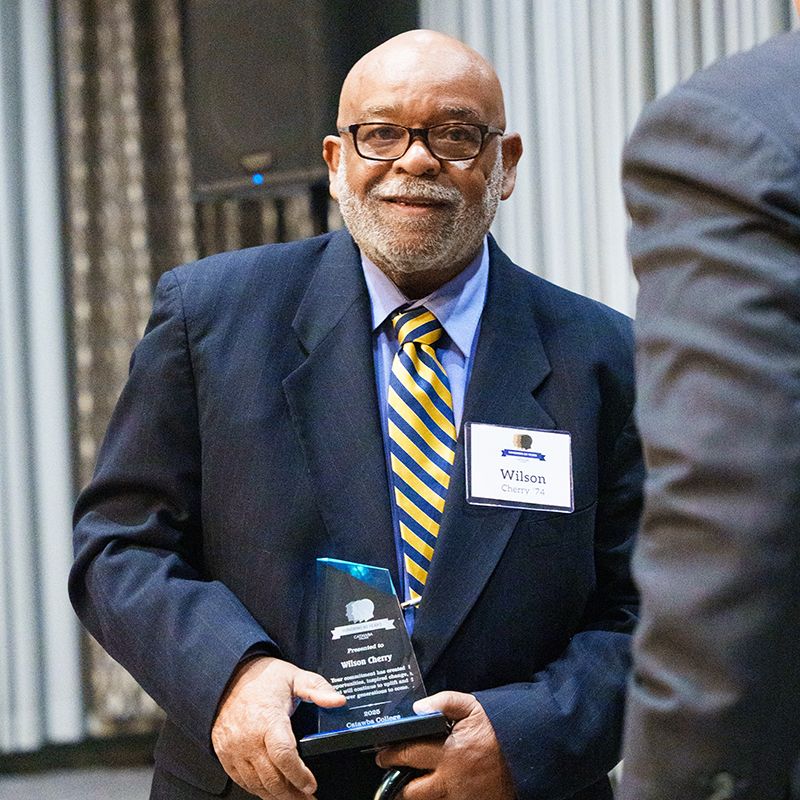
WILSON CHERRY '74
- Political Science
- Director of Community Affairs and Government Relations, Rowan Vocational Opportunities
“Catawba gave all of that to me, so I give back to give others the chance I got.”
Wilson Cherry never expected to go to college. His mother was a maid for 48 years. His father had an eighth-grade education and was a double amputee. College wasn't part of the picture, until a prank, a poem, and a national championship changed everything.
A Salisbury native and Catawba Class of 1974 graduate, Cherry spent his career building opportunities for people with disabilities, received the Governor's Award for community service in 2002, and met with President Obama in 2012 on behalf of The Arc to advocate for removing the word "retarded" from federal language. He came out of retirement in 2020 to raise funds for a new facility at Rowan Vocational Opportunities, where he serves as Director of Community Affairs and Government Relations. He says he wants to be known as a man who lived by the Golden Rule, and by every account, he has.
FROM A PRANK TO A NATIONAL CHAMPIONSHIP
Misled by classmates to write a poem instead of an essay on brotherhood, Cherry's work went on to win a national competition, and launch a new sense of what was possible for him.
A FULL RIDE
Catawba gave Cherry room and board on a full scholarship, allowing him to stay close to his disabled father while earning his degree, the deciding factor in choosing Catawba over Livingstone College.
GOVERNOR'S AWARD, 2002 | OBAMA, 2012
Two milestones in a career built entirely around lifting others, from community service recognition to helping change federal language for people with disabilities.
The Boy from Salisbury
Wilson Cherry grew up in the country, in a household where reading was demanded and church was non-negotiable. His mother, who worked as a maid for 48 years and never swore or chewed tobacco, walked him and his younger brother to the library and asked every single day what they had learned. His father, a double amputee with an eighth-grade education, was a devoted Presbyterian and a constant presence. Neither parent had made it through high school, but both taught him what they knew about educating the head and the heart. He ran track, played basketball, developed a love for reading, and grew up understanding that skill and talent mattered as much as compassion and empathy.
Brotherhood
His senior year of high school brought integration. Two schools merged, and Cherry was chosen by the governor to travel to schools to speak about making the transition smooth. Then came the prank. He missed a class, and white classmates told him the assignment was to write a poem rather than an essay on brotherhood. He wrote the poem. It went on to win a national championship. He received a scholarship, but because his father was a double amputee, he chose to stay local. Livingstone College wouldn't fund housing. Catawba gave him a full ride with room and board. That decision, born out of family loyalty and a poem written on false pretenses, changed the course of his life.
Learning How to Learn
At Catawba, Cherry says, he learned how to learn. He learned how to write, how to speak on his feet, how to communicate what was inside him, things he didn't know were there until professors like Dr. Singer and Dr. Sanford Silverburg pulled them out. Silverburg, the most liberal person Cherry had ever met, pushed him to go as far as he could see, and then see further. Singer, more conservative by nature, taught him about world life view, different religions, different cultures. Both challenged him. Both supported him. He was on the newspaper staff, in student government, traveling with the basketball team as a sports writer, not because it was his sport, but because the coach opened the door and handed him an opportunity. Catawba, he says plainly, opened doors he had no idea existed.
A Career Built on Lifting Others
The career that followed was a direct expression of what Catawba had cultivated. Cherry spent decades at Rowan Vocational Opportunities building pathways for people with disabilities, connecting them to community, advocating for their rights, and mentoring Catawba interns along the way. In 2002, he received the Governor's Award for community service. In 2012, The Arc sent him to Washington, where he met with President Obama to advocate for removing the word "retarded" from federal language. He received the Catawba Trailblazer Award for that work. In 2016, a drunk driver hit him and left him with a traumatic brain injury, a condition that ironically would qualify him for services at the very agency he has given his life to. He came out of retirement in 2020 to raise funds for a new facility.
The Golden Rule
Cherry is an elder in his Presbyterian church, a United Way volunteer, a Salvation Army bellringer, and a member of the Catawba Black Alumni Network. His legacy, as he describes it, is straightforward: he wants to be known as a man who was Christ-like and who always lived by the Golden Rule. He gave to Catawba to give others the chance he got. He taught Catawba interns because someone opened doors for him. He wants to be remembered as a man who never looked down on another person unless he was lifting them up. For someone who grew up in a house where college was not part of the plan, the distance covered is nothing short of remarkable.
TOGETHER, WE CAN DO A WORLD OF GOOD.
The Where Our Good Goes campaign is a comprehensive campaign with the goal of securing Catawba College for generations to come.
