FACES of GOOD
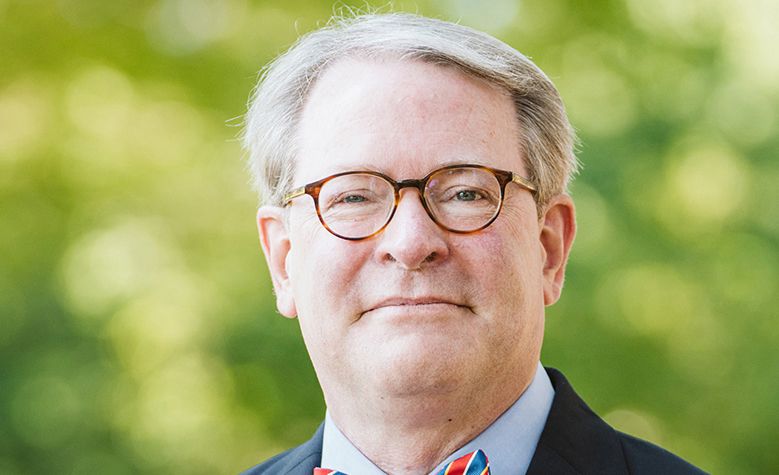
MICHAEL BITZER
- Professor of Politics and History
- Catawba College Faculty Since 2002
- Director, Center for North Carolina Politics & Public Service
“Your career is going to be a ladder; sometimes that ladder is going to branch off into a different direction that you have no idea that the previous rung was setting you up for.”
Michael Bitzer has been teaching politics and history at Catawba since 2002 with one clear north star: don't just get them ready for their first job, get them ready for every job they'll ever have. A product of a small liberal arts institution himself, Bitzer knew what that kind of education could do, and he set out to be even a fraction of what his own professors were to him.
More than two decades later, the emails keep coming, from law school first-years, from city administrators, from PhD researchers, all saying some version of the same thing: what you prepared me for, I am experiencing. His track record speaks for itself, but it's the individual stories that tell you what kind of teacher he actually is.
LAW SCHOOL ACCEPTANCE
Every student who majors in politics with the pre-law concentration at Catawba and applies to law school has gotten into at least one, a record that has held since before Bitzer arrived and continues under his watch.
THE CAREER LADDER
Bitzer teaches students that their career isn't a straight line, it's a ladder that branches in unexpected directions, preparing them for jobs that don't yet exist.
FROM CATAWBA TO CAMBRIDGE TO CITY HALL
Bitzer's graduates hold positions ranging from Director of Research at UNC Charlotte's School of Data Science, to city administrator in York, SC, to city council member in Kannapolis, built on a foundation of transferable skills, not a single job track.
Not Just the First Job
Michael Bitzer went to a small liberal arts institution for his own undergraduate education and felt the difference it made. He knew if he could replicate even a fraction of what his professors had done for him, he would call his career a success. At Catawba, he found exactly the environment that philosophy required, small enough to know every student, demanding enough to push them beyond their comfort zones, and committed enough to the long view that no one was optimizing for the wrong outcomes. He doesn't measure success by where students land their first job. He measures it by the emails he gets five and ten and fifteen years later.
The Confidence to Handle the Rigors
The emails always say something similar. They come from the first semester of law school, usually. They say thank you for pushing them when they needed it, because now they can handle the rigors, and they are just as prepared as, if not better prepared than, their classmates from much larger institutions. The pattern tracks with what Bitzer sees again and again: students who arrive with the intellectual capability but not yet the self-confidence, and who leave with both. Jason Windett arrived as one of Bitzer's first full graduating classes, bound for law school. By his junior year, he knocked on Bitzer's door and said he wanted to do what Bitzer did. He went on to earn a PhD in political science, taught at Saint Louis University, and is now a full professor and Director of Research at UNC Charlotte's School of Data Science.
Building the Middle Class
Bitzer frames the work at Catawba in terms that go beyond individual career outcomes. He studies U.S. politics and history, and what he sees in Catawba's student body, heavily first-generation, crossing socioeconomic lines, is a machine for building the middle class. A college education gives students the capabilities and adaptability to navigate an economy that is shifting faster than anyone can predict. The confidence-building, the embedded values, the ability to think across disciplines and repackage arguments, these are the things that position students not just for the job in front of them, but for the ones that don't exist yet.
Beyond the Major
Bitzer is deliberate about interdisciplinary engagement. He tells students their career will take them in directions they cannot predict, and that the skills they are building, communication, critical thinking, analytical problem-solving, listening to the other side, will serve them in any field. Ryan Dayvault came in with strong partisan views. By the time he was in an upper-level economics class, a classmate turned to him after he walked through both sides of an argument and said, "You've been hanging around Bitzer too long, Ryan." Dayvault now serves on the Kannapolis City Council and works at the North Carolina Research Campus. That, Bitzer says, is what happens when you teach people to think rather than just agree.
Preparing for Jobs That Don't Exist Yet
He gives students a metaphor: the career ladder. Every rung you climb sets you up for a direction you didn't see coming. One of his students is now the city administrator for York, South Carolina, and working on his Doctorate in Public Administration, a path he couldn't have mapped from his first-year seminar, but one that made perfect sense at every step. That's the kind of preparation Bitzer is after. Not the résumé that gets you through the first door, but the foundation that helps you build the whole house.
TOGETHER, WE CAN DO A WORLD OF GOOD.
The Where Our Good Goes campaign is a comprehensive campaign with the goal of securing Catawba College for generations to come.
